Hey everyone, let’s talk about something we get asked all the time as a flexible flat cable supplier: what’s the actual difference between flexible flat cable (FFC) and flex ribbon cable? Spoiler—way too many people mix these two up, and honestly, I get it. They look similar at first glance, right? Thin, flat, flexible strands, both used for connecting small electronics. But if you’re working on a design or sourcing parts for a build, mixing them up can cause headaches—like connections that fail mid-assembly or extra costs you didn’t plan for. Let me break this down straight, no corporate jargon, just what we see every day working with these cables for everything from phones to medical devices. Flexible Flat Cable
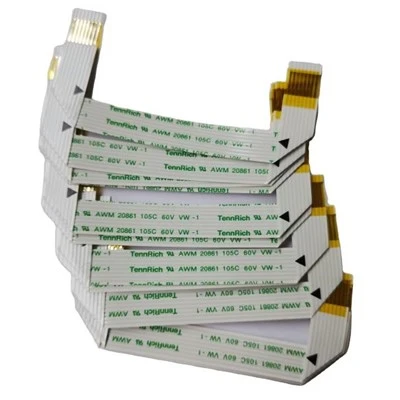
First, let’s start with the basics that most people miss. Flex ribbon cable—wait, is that the same as FFC? No, not even close, though the names sound interchangeable. Let’s go back to their core construction because that’s where the split happens. Flex ribbon cable (sometimes just called “ribbon cable” in old tech talk) is, at its heart, a flat array of individual wires bonded together along their entire length with a thin adhesive. The wires themselves are usually solid copper, super thin, and they run parallel to each other, no insulation between the wires themselves—just that outer adhesive layer. Now FFC, the flexible flat cable we supply, is different: each tiny conductor (usually copper, sometimes tin-plated for corrosion resistance) has its own individual insulation. Like, each wire is wrapped in a thin layer of polyimide or polyester, and then those insulated wires are pressed together with a single top and bottom polyimide film as the outer jacket. That insulation per wire is a game-changer.
Wait, let’s test that with a quick example you can probably see if you have a spare cable around. Grab an old laptop’s hard drive ribbon cable—yep, that’s a flex ribbon cable. If you gently peel a tiny edge of it, you’ll see those copper wires are right next to each other, no plastic around them. Now grab a small flex cable from a phone’s camera connector—that’s FFC. Peel a corner (be gentle, don’t break it) and you’ll see each copper line has its own thin yellow or white insulation coating. That’s the first, easiest way to spot the difference in 2 seconds.
Next up: flexibility and performance. This is where FFC really stands out, and why it’s our go-to for so many applications. Flex ribbon cable, because those wires are uninsulated and bonded thin, is flexible, but it’s not built for constant bending. If you bend it back and forth a bunch—say, if you’re designing a cable that connects a flip phone’s screen to its body, or a medical device that has a moving arm—the uninsulated wires will start to fray or short against each other really fast. We’ve had customers come to us after switching to ribbon cable for a wearable device, and within a week of testing, the cable failed because the wires touched. FFC, on the other hand, is designed to withstand repeated bending cycles. The individual insulation between conductors means even if you bend it 10,000 times or more, the copper wires don’t touch, and the outer polyimide jacket is way more durable. That’s why you’ll see FFC in foldable phones, car dashboard displays, and surgical tools that move around a lot—applications where constant flex is non-negotiable.
Wait, but what about cost? That’s a big one for buyers, and I won’t sugarcoat it. Flex ribbon cable is almost always cheaper, at least upfront. It’s simpler to manufacture—fewer layers, no individual insulation per wire, so production lines run faster and material costs are lower. But here’s the catch: if you’re using it for an application that moves, those “cheaper” cables end up costing more in the long run because you’re replacing them way more often. We see this with hobbyists too—someone will buy a $5 ribbon cable for a robot project, and 3 months later it breaks, so they have to buy another $5 cable. Whereas a FFC might be $10, but it lasts 10 times longer, so you end up saving. It’s a trade-off between initial cost and durability, and that’s where knowing the difference matters.
Then there’s conductor count and spacing. Let’s talk numbers, because this is another area where the two cables differ. Flex ribbon cable typically has a conductor pitch (that’s the space between the centers of each wire) that’s standard—most common is 0.05 inches, or 1.27mm. You can get wider pitches too, but it’s not super flexible. FFC, though, is built for smaller, tighter pitches. We supply FFC with pitches as small as 0.3mm, which is way smaller than what you can get with ribbon cable. Why does that matter? If you’re designing a tiny device, like a smartwatch or a hearing aid, you need a cable that fits in a small space, with lots of connections without taking up too much room. Ribbon cable can’t get that tight because the uninsulated wires would short out if they’re too close together. That’s why most small electronics use FFC now, not ribbon—space is at a premium, and tight pitches let engineers pack more connections into a thinner cable.
Wait, let’s not forget about connectors. You can’t just take any cable and plug it into any connector, right? The connector style for each cable is totally different. Flex ribbon cable usually uses a IDC (insulation displacement connector) that clamps onto the flat cable, and since the wires are uninsulated, the connector’s blades pierce through the adhesive to make contact. FFC also uses IDC connectors, but they’re specifically made for insulated conductors—so the blades pierce through each wire’s individual insulation to get to the copper inside. If you try to plug a FFC into a ribbon connector, it won’t work, and vice versa. We’ve even had a few new customers mess this up at first—they ordered ribbon cable, got the wrong connector, and had to reorder. That’s another hidden cost of not knowing the difference.
Let’s talk about real-world use cases, because that’s the best way to see which is right for you. Flex ribbon cable is still used, don’t get me wrong—places where there’s little to no movement, like internal connections in a desktop computer, old printer ribbon cables, or simple audio devices that don’t move. Those are areas where the cheaper, simpler ribbon cable works perfectly. But FFC is everywhere now where motion or tight space is involved: foldable phone hinges, electric car display connections, drone camera gimbal cables, even some home appliance controls (like the cable that connects your fridge’s door button to the control panel). We had a customer last year who makes portable X-ray machines—they used ribbon cable before, but the cables would break when the machine was folded for transport, so they switched to our FFC and cut their failure rate by 90%—that’s a big win for them.
Wait, what about common myths? I hear a lot of people say “FFC is just a brand name” or “flex ribbon cable is the same thing just in a different color.” No, that’s not true at all. The construction is fundamentally different. I’ve seen some online forums where people argue about this, but they’re usually basing it on 20-year-old tech that mixed up the terms. Let’s clear that up once more: FFC = each conductor has individual insulation, outer polyimide jacket, designed for repeated bending. Flex ribbon cable = uninsulated wires bonded with adhesive, no individual conductor insulation, designed for static use. That’s the hard line, no exceptions (okay, there are a few specialty variations, but for 99% of applications, that’s the rule).
Another thing: durability in harsh environments. Both cables are flexible, but FFC handles heat and chemicals better, too. The polyimide outer jacket on FFC can withstand temperatures from -55°C to 125°C, which is why it’s used in cars and aerospace—places where temperatures swing a lot. Ribbon cable’s adhesive layer breaks down faster in high heat or if it’s exposed to oils or solvents, so it can’t handle those harsh environments. We supply a lot of FFC for industrial machinery that uses hydraulic fluids—ribbon cable would fall apart after a few months, but our FFC lasts years.
Now, let’s talk about when to pick which. If your project is a static application, no movement, lots of space, and you want to save on upfront cost, flex ribbon cable is fine. If your project has any moving parts, tight space, needs repeated use, or has to handle extreme temperatures, FFC is the way to go. And don’t forget to match the connector—we see so many people skip that step, which ends up being a waste of time and money.
As a FFC supplier, I’ll be honest: we want you to order FFC, but that doesn’t mean I’m going to tell you to get the wrong cable for your project. If you’re working on a simple desktop build, I’ll suggest ribbon cable, because it’s a better fit. But if you’re building something that moves, or needs to be small and durable, FFC is the only option. The worst thing that can happen is you order the wrong cable, spend extra time and money returning it, and delay your project—so taking 5 minutes to understand the difference is totally worth it.
A lot of new engineers or hobbyists ask me if there’s a middle ground, and honestly, not really. There are some hybrid cables, but they’re specialty and way more expensive. For most people, it’s one or the other. I’ve even seen someone try to modify a ribbon cable to act like FFC, adding insulation to each wire, and it doesn’t work—you end up with a clunky cable that’s stiffer and more expensive than just buying the right FFC.
Wait, let’s circle back to that visual test I mentioned earlier. If you have a cable laying around right now, take 10 seconds to check. Peel a tiny corner (be careful not to damage it) and look at the conductors. If each has its own thin plastic coat, it’s FFC. If they’re all bare right next to each other, it’s flex ribbon cable. That’s the easiest way to tell, no measuring tools needed.
For anyone sourcing these parts, here’s a quick checklist to make sure you don’t mix them up:
- What’s the application? Static or moving? (Moving = FFC)
- How much space do you have? Tight space = FFC’s tight pitches work better.
- What’s your environment? High heat, chemicals, or bending? = FFC.
- Initial vs long-term cost: Cheaper upfront = ribbon, better long-term = FFC.
We’ve been supplying FFC for over a decade, and in that time, we’ve helped thousands of customers pick the right cable for their projects—from small hobby builds to large industrial contracts. We’ve seen the mistakes people make when they mix up FFC and ribbon cable, so that’s why I’m putting this out there straight, no sales pitch hidden in the explanation.
If you’re working on a project right now and aren’t sure which cable you need, or you have specific requirements (like a certain pitch, length, or temperature rating), feel free to reach out to chat. No, we won’t spam you, and we won’t push you to buy something you don’t need. But we can help you figure out if flex ribbon cable or FFC is the right fit, and if you do end up needing FFC, we can supply custom lengths and specs tailored to your project.

At the end of the day, the difference between FFC and flex ribbon cable isn’t just semantics—it’s performance, cost, and whether your project works or fails. Don’t let the similar names confuse you. Know your use case, check the construction, and pick the right one. That’s how you avoid a lot of headaches down the line.
Wire Harness References
- Electronic Materials and Components Handbook, CRC Press, 2021
- Flexible Flat Cable Design and Application Guide, International Electrotechnical Commission (IEC) Standard 60352-5, 2018
- Ribbon vs Flat Cable: Performance Comparison, Journal of Electronic Manufacturing, Vol. 28, No. 3, 2019
- Automotive Wiring Systems: Flex Cable Requirements, Society of Automotive Engineers (SAE) Standard J1128, 2020
Tennrich Electronics Technical Development (Kunshan) Co., Ltd.
As one of the most professional flexible flat cable manufacturers and suppliers in China, we’re featured by quality products and low price. Please rest assured to buy cheap flexible flat cable for sale here from our factory. We also accept customized orders.
Address: NO.159 South Wusongjiang Road ,Kunshan Economic Technical & Development zone,Suzhou city,Jiangsu province, China.
E-mail: foreigntrade@tennrich.net
WebSite: https://www.china-ffcs.com/
